The city that built itself around a pond - and the wetland that takes what it throws away
Last revised July 2026. A long-read companion to the live dashboard and facts page. Dashboard - Facts
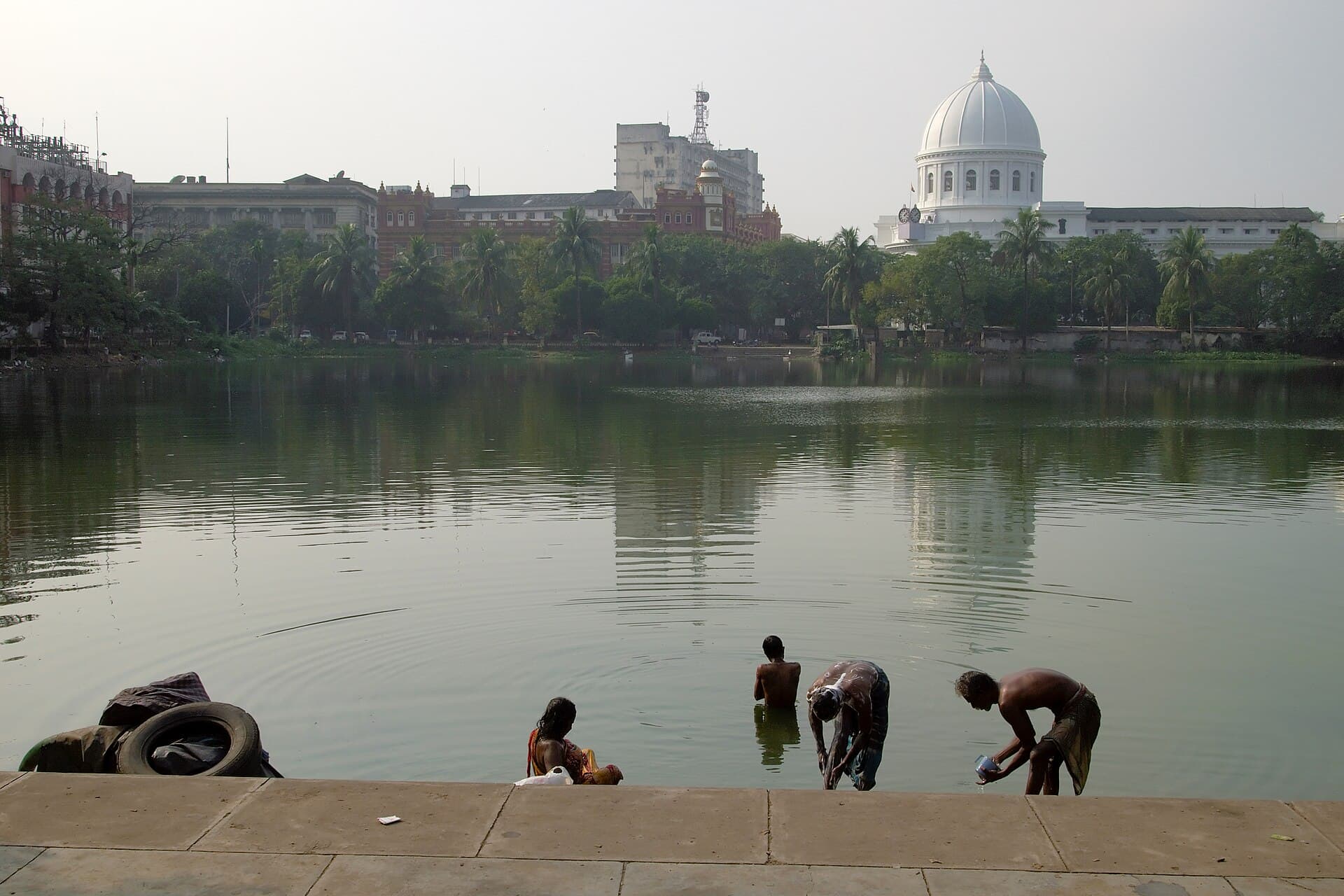
In the middle of Kolkata's administrative core, under the dome of the General Post Office and surrounded by the buildings from which an empire was once run, there is a pond - and people are washing in it. Lal Dighi, the red tank, which the British called simply the Great Tank, was here before the offices were, and the city arranged itself around it. Three centuries later it is still doing domestic work. That is the founding fact, and it is worth holding onto, because Kolkata went on to fill roughly 44% of its ponds within two decades. The names survive where the water does not: Beniapukur, Manoharpukur, Jhamapukur, Shyampukur - pukur(পুকুর) means pond, and KMC's own road directory lists sixty-one streets named after water bodies. Meanwhile the city's single largest piece of water infrastructure is not a plant or a reservoir but a wetland it does not own, lying outside its boundary, treating 910 of Kolkata's 1,400 million litres of sewage a day in fish ponds - roughly five times what all five of the city's treatment plants manage between them. Kolkata is not running out of water. It is a city defined by water it cannot get rid of.
A city you could swim across (c. 1690-1900)
Kolkata grew on a deltaic plain where the problem was never finding water but draining it - so it organised itself around tanks, and named itself after them.
The three villages that became Calcutta sat on the east bank of the Hooghly, on ground so flat and so wet that the founding engineering problem was not supply but disposal. Rain fell - about 1,650 millimetres a year - onto clay that would not absorb it, in a delta with almost no gradient to carry it away. The answer, repeated thousands of times across the settlement, was the tank: dig a pond, pile the spoil into a building platform, and let the hole hold the rain. Every tank was simultaneously a borrow pit, a reservoir, a bathing place, a fishery and a firebreak.
The result was a city so dense with ponds that you could, as the environmentalist Mohit Ray has put it, swim across Kolkata from one pukurto the next. The toponymy is the proof: Monoharpukur, Ahiripukur, Bosepukur, Thakurpukur, Paddapukur, Talpukur, Keorapukur, Hanspukur, Shyampukur, Muraripukur, Jorapukur, Jhamapukur, Beniapukur, Fariapukur, Chunapukur, Tanupukur. Sixty-one roads in KMC's own 2006 directory carry a water body's name.
Two things followed from building on a tidal delta rather than a river plain. First, the city never impounded anything: there is no dam anywhere in Kolkata's water system, then or now. Second, the drainage had to be engineered from scratch - and in the nineteenth century it was, as a combinedsystem, carrying sewage and stormwater in the same conduit. That decision is still the single most consequential fact about Kolkata's water, and we will come back to it twice.
Six millimetres an hour (1870s-present)
The Victorian sewers were built to a published standard. The standard has not changed; the rain has.
KMC's own sewerage document states it plainly: the main network "was designed to discharge a rainfall of 6 mm. per hour". That is the promise the city's drains make. Around it sit 180 kilometres of century-old brick sewer and pumping stations that the corporation says were built fifty to a hundred years ago. As late as 2004-05 the whole city had one storm-water drainage pumping station; by 2009 it had four.
We took twenty-six years of hourly rainfall - 232,896 hours, 2000 to 2025 - and asked how often the sky beats six millimetres. The answer is a mean of 31.8 hours a year. But the record splits almost in half: 19.2 hours a year in 2000-2012, against 44.5 in 2013-2025. In 2025 the standard was beaten for 59 hours across 50 separate days. The wettest hour on record delivered 40.2 millimetres - 6.7 times what the sewers were built to carry.
“Designed to discharge a rainfall of 6 mm. per hour.”
What that looks like on the ground is not an annual catastrophe but a weekly routine. KMC publishes a chart every week listing the waterlogging pockets it has sent de-silting machines to. In one ordinary week of July 2026 our capture recorded 66 pockets across 53 wards and 15 boroughs, with 469 machine deployments; the week we captured in August named 60 pockets across 55. Neither is a spike. The corporation lists its own causes without flinching: siltation, collapsing brick sewers, century-old pumps, silted outfall canals - and the destruction of wetlands increasing runoff.
Because the system is combined, every one of those hours does two things at once. It floods the street, and it pushes untreated sewage into the canals. In Kolkata, a drainage failure and a pollution event are the same event.
The river that stopped breathing
The original course of the Ganga runs through south Kolkata past one of Hinduism's great temples, and carries no dissolved oxygen at all.
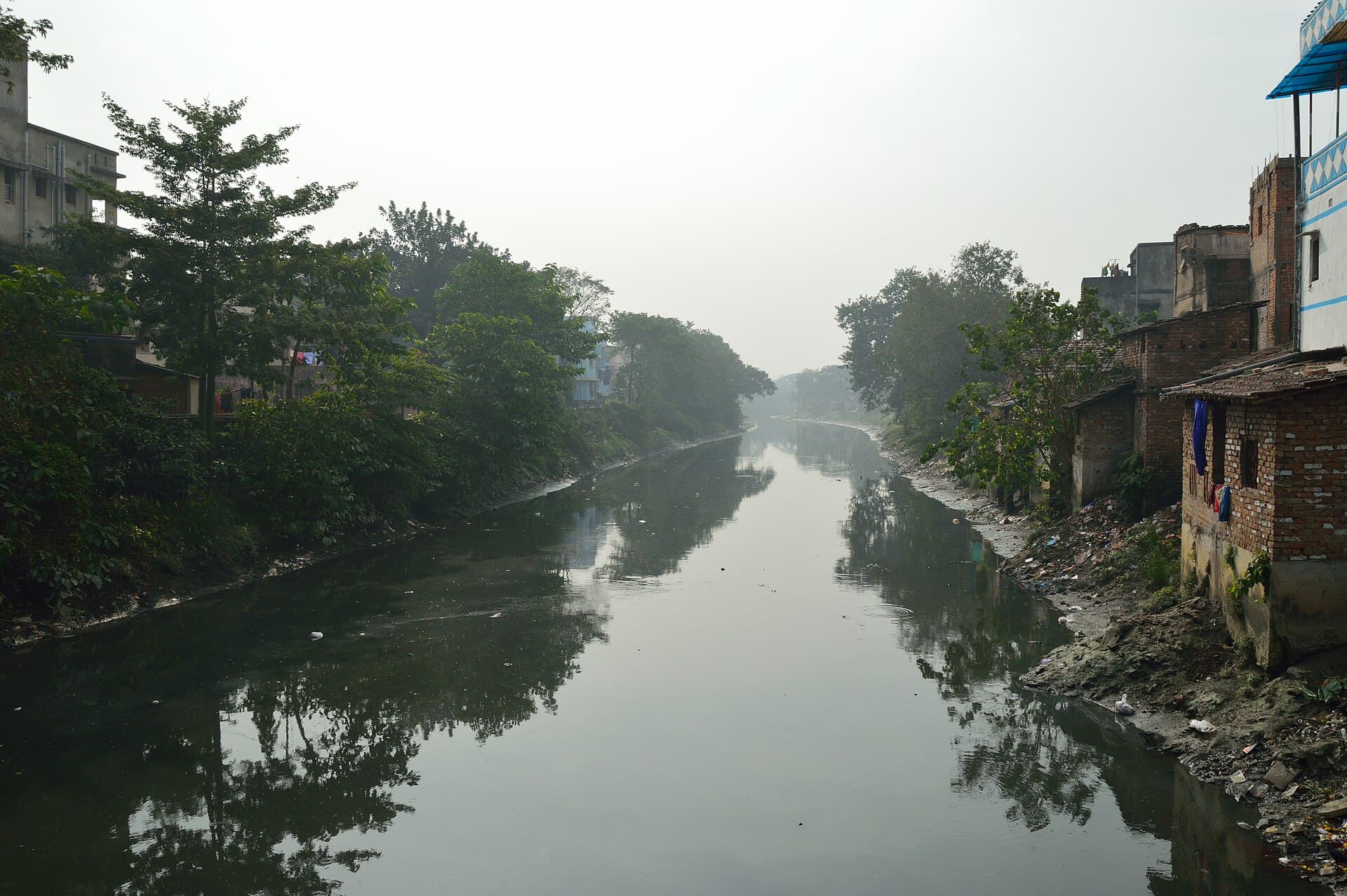
The Adi Ganga is not a minor drain with a grand name. It is the adi- the original - course of the Ganga, the channel the river ran down before it shifted west, and it passes Kalighat, the temple the city takes its name from. In 1777 Major William Tolly had it dredged as a navigation cut, which is why it is also called Tolly's Nullah.
West Bengal's Pollution Control Board samples it at six points, and does something no other monitoring programme on this platform does: it samples each point separately at high tide and at low tide. The Hooghly is tidal this far inland, so the same location is a different water body six hours apart. Keeping the two apart, rather than averaging them, is the only honest way to measure a tidal channel - and it produces a finding the average would have erased.
On 7 May 2026 at Bansdroni, the board's own observers recorded the water as "Blackish" and "Pungent". Dissolved oxygen: NIL. Faecal coliform: 4,900,000 MPN per 100 ml. That is the high-tide reading. At low tide, the same day, the same point: BOD 14.53 against 10.75, faecal coliform 8.4 million against 4.9 million. Less dilution, more concentration. Dissolved oxygen was nil at every monitored point along the channel.
Four kilometres away the Hooghly itself - the city's actual drinking-water source, abstracted at Palta some twenty-two kilometres upstream - was running dissolved oxygen above 6 mg/l and BOD around 2. The mainstem is not the story. What the city does to its own smaller channels is.
The wetland that does the work
Kolkata's largest sewage treatment plant is not a plant. It is 12,500 hectares of fish ponds outside the city limits, and nobody built it.
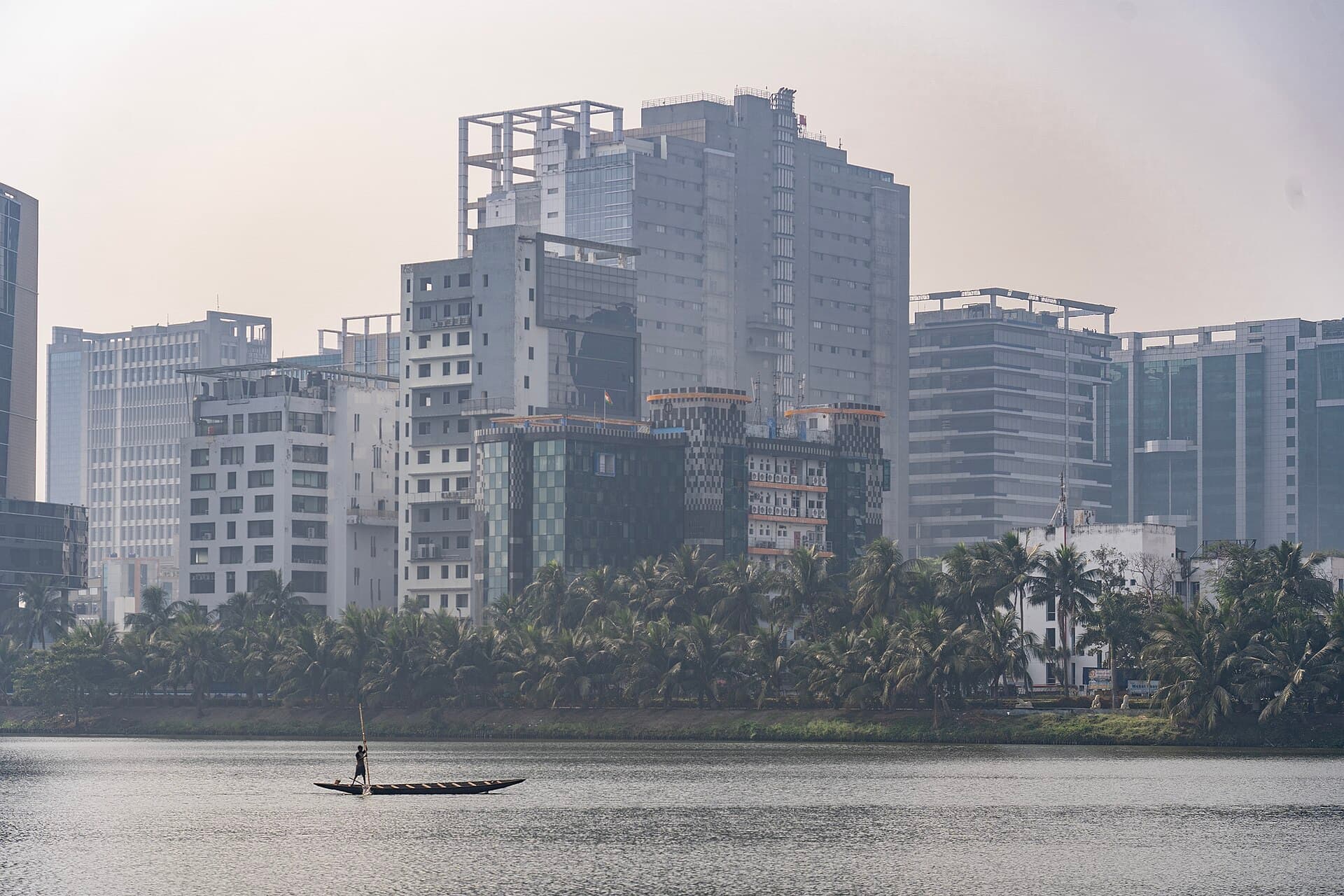
When the Bidyadhari river silted up in the early twentieth century, Kolkata's eastward drainage failed. What grew in its place was not an engineering scheme but a livelihood: fish farmers discovered that the city's sewage, let into shallow ponds and worked by sunlight and algae, grew fish. Over decades this became the largest wastewater-fed aquaculture system in the world - 12,500 hectares, 254 sewage-fed fisheries, 37 mouzas, protected since 2006 by its own Act and listed as a Ramsar site.
By KMC's own statutory accounting, the wetlands treat 910 of the city's 1,400 MLD. The five actual treatment plants manage 179. A further 311 MLD - 22.21% - is untreated or only partly treated. So the principal sewage infrastructure of a city of four and a half million people is unbuilt, unpaid for, unengineered, under continuous real-estate pressure - and lies outside the corporation's boundary, in North and South 24 Parganas.
“910 MLD in EKW fisheries + 179 MLD in existing 5 nos. STPs = Total 1089 MLD.”
Ten more plants are planned, adding 280.06 MLD. Even if every one is built, 30.94 MLD stays untreated - and that arithmetic assumes the wetlands keep absorbing 910 MLD indefinitely. As of December 2025, five of the sewerage packages financed under an Asian Development Bank loan had been awarded, contractors mobilised, work formally commenced in October - and every one of them stood at 0.0% physical progress.
What the numbers refuse to say
Kolkata's water problem is unusually well documented and unusually badly counted - and several of the gaps are the corporation's own admissions.
Some of what is missing here is missing on the record, which is rarer and more useful than it sounds. KMC's statutory Environment Plan leaves the entire industrial-wastewater section blank, every field empty, naming the state pollution board as responsible. That is a corporation declaring a gap in its own legally mandated plan.
The corporation also contests its own population. The same Environment Plan gives more than 4.5 million residents and a floating population of six million a day; KMC's water-supply pages frame demand off a "static population" of 44.96 lakh. Whatever litres-per-capita figure anyone quotes for Kolkata, the denominator is disputed by the publisher - which is why this platform publishes none. For the same reason it publishes no total supply capacity: KMC's own page lists plants summing to 2,324.7 MLD beside a target of roughly 1,900, on a page labelled draft and footered 2013.
Nobody agrees how many ponds there are either. For 2006 alone there are four published counts: KMC's own list said 3,873, the National Atlas organisation's map census said 8,731, a satellite count said 4,889, and KMC's earlier 1997 list had said 1,786. That last pair is the trap - KMC's count went up, which is not ponds appearing but the corporation searching harder. The 44% loss figure comes from comparing the map census against the satellite count in the same year. KMC is now, finally, commissioning a fresh inventory; the one it has been working from was compiled in 1993.
Even the groundwater refuses the usual framing. The national assessment does not classify Kolkata district as safe, or critical, or over-exploited. It classifies it as saline- a water-quality category, not an extraction one - so the district has no extraction stage at all. Around it, the arsenic belt: 42.4% of North 24 Parganas habitations affected, in the district that holds both Kolkata's intake at Palta and its fastest-growing suburbs.
What it would take
Kolkata's fixes are unusually legible, because most of them are already written down by the people responsible.
Count the ponds. The single cheapest intervention is the inventory KMC has already commissioned. A city cannot protect water bodies it has not enumerated since 1993, and the West Bengal Inland Fisheries Act already prohibits filling any water body of five cottahs or more without permission. The law exists; the register does not.
Treat the wetlands as infrastructure, not scenery. 910 MLD of treatment capacity that nobody built and nobody pays for is the largest untracked asset on this platform. It has an Act, an authority and a charge-sheet register - and no line in the corporation's capital budget commensurate with what it does.
Publish the drainage network.KMC has 80 per-ward drainage maps. They are PDFs. Chennai publishes 10,308 surveyed drain segments as data; Kolkata's equivalent exists on paper only, which means nobody outside the department can analyse where the system fails.
Restore the early-warning system.The programme that built Kolkata's flood early-warning system still links to it. As of July 2026 the domain no longer resolves. A city that floods as a weekly operating condition has no public warning surface at all.
None of these require a new dam, a new river, or a new treaty. Kolkata has enough water. What it has never had is an honest account of where that water goes - and, for a hundred and fifty years, drains built for six millimetres of rain an hour in a city that increasingly gets more.
See the live Kolkata dashboard