The history of water in Madurai
Last revised May 2026. A long-read companion to the live dashboard and facts page. Dashboard - Facts
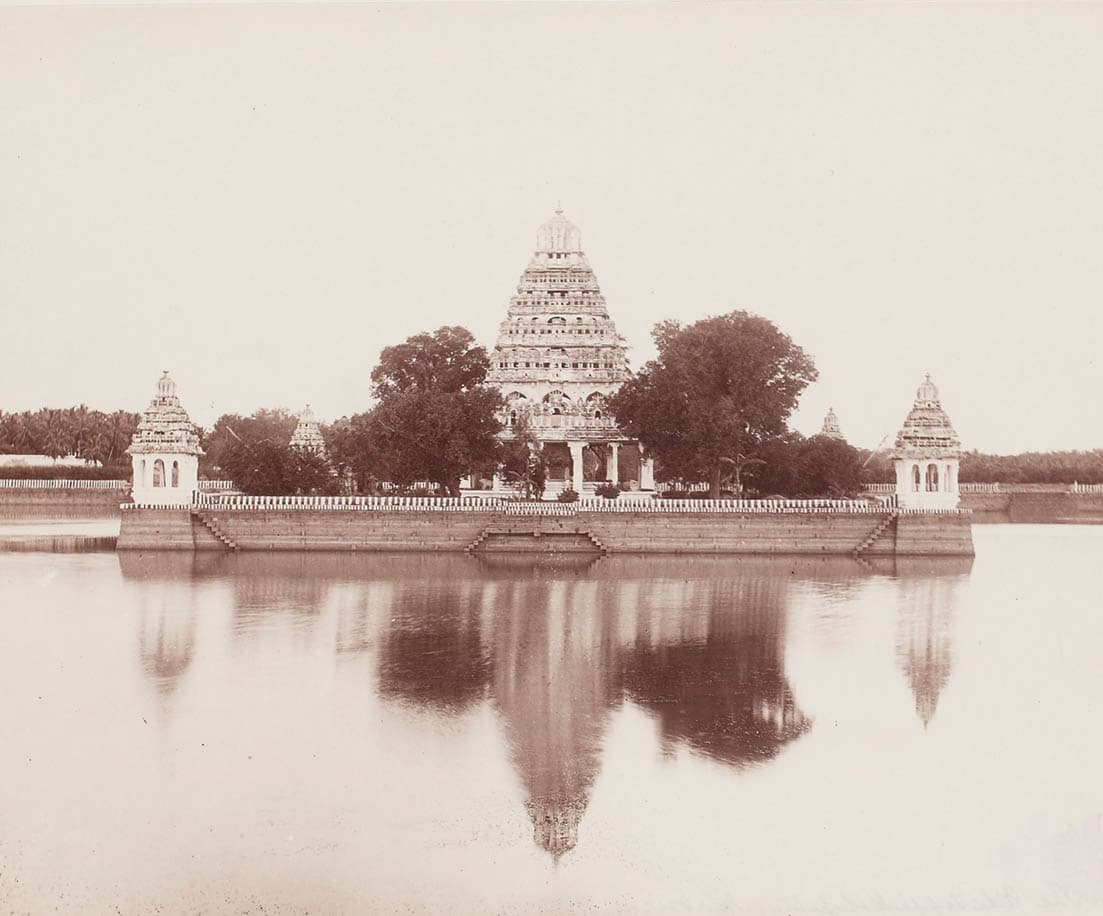
Madurai has been many cities under one sky. To the Sangam-era poets it was Koodal Maanagar (கூடல் மாநகர்), the city of the assembly. Today it is Thoonga Nagaram (தூங்கா நகரம்), the city that never sleeps. Its deeper name is older still: Marutham, the Sangam-era word for the riverine, paddy-growing landscape itself. For two thousand years that landscape had its water - a hydraulic civilisation that linked roughly 2,500 tanks (kanmoi, கண்மாய்) into a single cascade fed by the Vaigai. Today the cascade is severed from the river that fed it; about a third of the city's historic tank surface no longer holds water. The cascade is not gone. It is just disconnected. The work this dashboard tracks is whether and how the connection comes back.
How water made Madurai
Madurai did not just have water infrastructure. It was water infrastructure.
Madurai is older than most surviving cities on earth. A second-century BCE Tamil-Brahmi inscription, deciphered by the epigrapher Iravatham Mahadevan, calls it matiray - the walled city. Earlier Brahmi inscriptions at Mangulam, twenty kilometres north, name workers of the Pandyan king Nedunchezhiyan I in the third century BCE - the oldest dated evidence of organised state presence in this landscape (Mahadevan, Early Tamil Epigraphy). The Greeks who reached this coast wrote of it as Methora; the nineteenth-century British colonial press called it the Athens of the East; and today it is popularly called Thoonga Nagaram, the city that never sleeps. Two thousand years of continuous habitation in a 900 mm-rainfall semi-arid zone - a place where, by every climatic argument, no city this large should exist, let alone stay awake all night.
What made it possible was not faith. It was hydraulics. The Pandyans, then the Madurai Nayaks, built a network of interconnected tanks called kanmoi (கண்மாய்) - earthen bunds holding back monsoon runoff, stone kalingusluices controlling release, and feeder channels connecting each tank both upstream and downstream to the next. Hundreds of them daisy-chained together formed a cascade. The overflow from tank N filled tank N+1, which filled N+2, all the way down a watershed. By the colonial gazetteers' count, the Madurai region held more than two thousand five hundred such tanks and minor structures.
This cascade did not just water fields. It made the city of festivals possible. Every Chithirai - the Tamil month that straddles April and May - Madurai swells past its working population to a million pilgrims for the celestial wedding of Meenakshi and Sundareshwarar at the Meenakshi-Amman temple. The dramatic centrepiece is not the wedding. It is the moment Lord Kallazhagar - the Vishnu deity who lives twenty-one kilometres away at the Azhagar Koyil hill temple - rides down from the hills as Meenakshi's brother, fords the Vaigai on horseback to attend the wedding, and turns back when he hears the rite is already complete. The river crossing is the iconic image. A million people line the banks for it. The Madurai Kanchi, a second-century CE Sangam composition by the poet Mangudi Marudan - literally “a counsel offered in Madurai” - describes this same temple-city's water culture two thousand years ago. The Tevaram of the seventh- and eighth-century Nayanar saints addresses the city as Thirualavai. None of those texts describe the god stepping over a dry riverbed of plastic and sewage.
A few months later, in the cooler month of Thai, the Vandiyur Mariamman teppakulam - sixteen acres of temple tank built in 1645 CE by Thirumalai Nayak, the same Madurai Nayak king who built the Tirumalai Nayakkar Mahal palace half a kilometre from the Meenakshi temple - fills to its stone steps and the float festival begins. The largest temple tank in Tamil Nadu was not a decoration. It was the bottom of a cascade. Without the channels that brought water in, the float festival cannot happen. Without the kanmoi above them feeding the channels, the channels do not flow.
“Surplus channels are the links of a chain, which function as the most efficient water-harvesting structures in arid plains.”
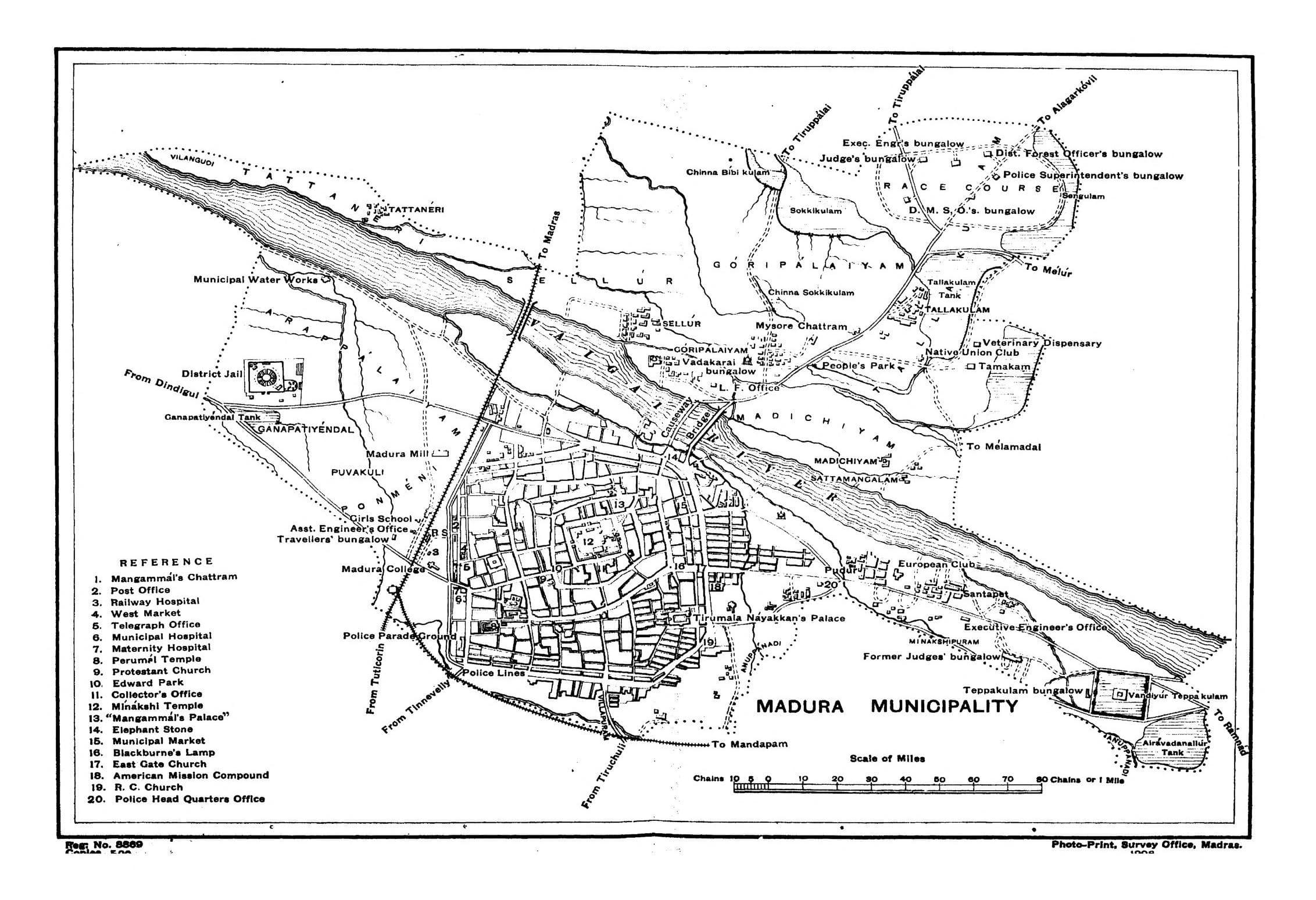
Seven named surplus channels carried the Vaigai's flow in and out of Madurai - Anuppanadi, Paniyur, Sottathatti and Avaniyapuram on the southern bank; Sellur, Pandalkudi and Vandiyur on the northern bank. Sixteen kilometres downstream, the Anaikondan kanmoi network in Tirumangalam taluk - sixteenth-century Pandyan-era engineering, still functional - was notified as Tamil Nadu's first Biodiversity Heritage Site in November 2022. Four centuries of continuous service before the state thought to formally protect it.
And this was not folk wisdom. It was state infrastructure, surveyed and budgeted. Tank maintenance was a tax-supported obligation called kudimaramathu - community tank repair - that ran continuously from the Pandyan period into the early colonial era. The Oxford anthropologist David Mosse, whose The Rule of Water (2003) is an ethnography of the Sivagangai-Madurai tank country, documents how this was simultaneously hydraulic infrastructure, caste-state authority, and temple economy - the same institution doing three jobs at once. To live in this region was to owe the cascade something. The kanmoi did not maintain themselves; nor did the people pretend they did.
How the cascade came undone
The cascade did not collapse from one cause. It was unwound, piece by piece, by named decisions across three eras.
The British East India Company found the kanmoi system working. The colonial engineering office did not see a functioning hydraulic civilisation; it saw obsolete plumbing. Large dams and centralised waterworks were modern. A two-thousand-year-old cascade maintained by farmer councils was, in the colonial mind, something to be replaced. Mosse's 1999 paper Colonial and Contemporary Ideologies of ‘Community Management’ argues that the very story of decayed kudimaramathu was constructed by colonial administrators to justify state takeover - the kanmoi did not stop working because the institution failed; the institution was first declared failed, and then starved of the authority that kept it running. The annual kudimaramathu obligation was folded into the Public Works Department schedule. The social capital that had kept the bunds repaired and the channels clear, that had taught the next generation which tank fed which, began to dissolve. Tanks that no one was responsible for slowly silted up.
In 1924 the British laid the city's first underground sewer, covering what was then the core - about thirty per cent of Madurai's present footprint. That number is worth holding on to. The other seventy per cent of today's Madurai - the part that grew after Independence, that buried tank beds under courthouses and bus stands and slum colonies - was added on top of the cascade without a sewer to match. The seven named surplus channels picked up the overflow by default. By the time the 2011 Jawaharlal Nehru National Urban Renewal Mission finally extended underground drainage to ninety per cent of households, the channels had already been storm and sewage drains for a generation. The colonial framing won twice: it dismissed the cascade first, then built nothing fast enough to replace what the cascade used to do.
After 1947, the colonial framing carried over. The Vaigai dam (1959) and the intensified Mullaperiyar tunnel diversion industrialised the upstream supply, while the downstream cascade - the channels and tanks the river fed - decayed without a department key performance indicator measuring it. From 1951 to 1971, rural-to-urban migration filled Madurai. The easiest land got built on first: dry-season tank beds, broad and flat, with no living owner to object.
“The District Court complex stands on Sengulam tank's bed. Madurai Corporation's offices stand on Tallakulam tank's bed.”
Fourteen named urban tanks are documented as completely lost. About sixteen and a half square kilometres of historic tank surface - close to a third of the historical wet city - has been built over (Vencatesan, Dying Tanks in Urban Areas). Roughly fifteen thousand households now live on what were once tank beds, on land that floods predictably when the monsoon remembers what the ground is.
But the deepest change was hydraulic, not legal. Two decisions, taken in living memory, severed the river from the cascade it used to fill.
One. The bund road laid along the Vaigai in the late 1990s - intended to give the riverbanks a motorable edge - destroyed the surviving ghats and encroached ten metres on both sides. The seven named surplus channels were paved over or repurposed as storm drains. They are now, every one of them, sewage drains. The pilgrims at Chithirai still bathe in the river. Lord Azhagar still rides down from the hill to ford it. The river they bathe in, the river he fords, is what flows out of those drains.
Two. Sand mining lowered the Vaigai bed itself. The bed dropped below the elevation of every channel intake along its banks. Even on a wet year, gravity will not lift water uphill into a channel that now sits metres above the stream. The cascade was no longer just blocked. It was physically decoupled from the river it used to draw from. The kanmoi did not lose their water; they lost their feed.
“The cascade is not gone. It is just disconnected.”
Where we stand now
The trajectory across the published record - Pandyan-era inscriptions, the 1906 gazetteer, late-twentieth-century studies, today’s telemetry - all point in the same direction. Some pieces have improved. The hydraulic system itself has not.
Madurai's water condition is one of the better documented in Tamil Nadu. The Pandyan inscriptions named the tanks. The 1906 Madras District Gazetteer mapped them. David Mosse's ethnography (The Rule of Water, Oxford, 2003) traced how their institutional authority unwound. K. Sivasubramaniyan's 2007 paper quantified Tamil Nadu-wide tank-irrigated area decline since 1961. The 2020-21 peer-reviewed Vandiyur cascade study (Sashikkumar et al., Discover Applied Sciences) tracked borewell depths along Madurai's flagship surviving network: roughly eight metres in the early 1990s, sixty metres by 2007, two hundred metres by 2017-18. India Water Portal's field studies recorded a 300% peri-urban land-cover increase between 2002 and 2018, with monsoon rainfall down 11.2% (NE) and 10.6% (SW) over the same window. Mongabay India's 2021 Vaigai feature established that about eighty-five per cent of the Vaigai dam's water now arrives via the Mullaperiyar tunnel from Kerala's Periyar catchment - the Vaigai's own basin contributes only fifteen per cent. The Columbia GSAPP and Thiagarajar College of Engineering studio (Water Urbanism in Madurai, 2016) was one entry in this lineage, not the foundation of it.
What follows is a comparison between what those sources documented and what our own pipeline measures from live feeds today.
Sanitation has improved. Legal frameworks have improved. Specific tanks - Vandiyur, Madakulam, Anaikondan in the Arittapatti BHS - have had bunds repaired and inflow channels cleared. The hydraulic system itself, the river-channel-tank cascade that defined this city for two thousand years, has not. Vaigai BOD downstream of Madurai has doubled in four years. Groundwater under the Meenakshi temple, under the Tirumalai Nayakkar Mahal, under the Vandiyur teppakulam, is being drafted faster than it recharges. The reservoirs that Chithirai and the float festival quietly depend on sit at single-digit-percent capacity in early summer. The cascade has not reconnected because no one in any department's plan has yet drawn the line from sand mining to bed drop to severed channel to dry kanmoi to dry teppakulam to a stalled festival no city will admit, in writing, that it is losing.
See today's live numbersWhat we owe it
The fix is not heroic. It is owed.
A city that has stood for two thousand years is not a private possession. It was given to us. The kanmoi we built our courthouses on were not ours to bury. The river we mined the bed out of was not ours to break. The obligation called kudimaramathu - that the people who used the cascade owed it maintenance - did not end when the colonial office stopped recording it. We just stopped paying.
“Shift the perception of tanks from neglected backyard to front yard of the city.”
What restoration looks like, concretely, is not glamorous. It is a sequence of unromantic decisions, some of them already in motion:
- The Madras High Court water-body registry. The March 2024 order in R. Manibharathi v Union of India directs Tamil Nadu to publish a public website listing every water body with survey number, location, original and present extent, within six months. Status: pending compliance. Until compliance happens, every tank is plausibly deniable.
- Madurai Smart City Mission and AMRUT-2 tank interventions. Discrete kanmoi - Vandiyur, Madakulam, others - have been de-silted, bunds repaired, inflow channels cleared. They are showing what a properly maintained kanmoi looks like in 2026. Single tanks though, not a cascade. Sakthivadivel and Shah's 2019 IWMI evaluation of Tamil Nadu's 2017 Kudimaramathu revival was sceptical for exactly this reason: state-led tank rehabilitation that does not also rebuild the social authority of kudimaramathu - the obligation, not just the engineering - tends to cosmetically restore one tank at a time and lose the cascade.
- The Rs 440 crore Vaigai cleanup proposal. Submitted by Madurai Municipal Corporation in 2024, covering pumping-station overhaul plus river cleanup. Status: pending Tamil Nadu government sanction.
What is missing from every one of those plans, and what this dashboard exists to surface: the sand-mining bed drop. The kanmoi cannot reconnect to the Vaigai unless the riverbed is either raised back up - check dams, sediment retention, banned mining enforced rather than scheduled - or the channel intakes are lowered to meet the new bed. Until that calculation appears on someone's engineering plan, every other restoration is a single-tank intervention dressed up as cascade revival. A temple tank fed only by direct rainfall is a swimming pool, not a teppakulam.
Madurai's names form a single civilisation - Koodal Maanagar of the Sangam, Marutham of the riverine landscape, the Athens of the East, the city of tanks, the city that does not sleep. Each describes a part of the same hydraulic continuity. Restoring the cascade does not mean rebuilding what was lost. It means reconnecting what is still there to the river that used to feed it. Some of that work is already underway. The rest is what this dashboard tracks.
See the cascade today on the mapQuotable facts and citations