The city that stored water for a thousand years - and the twenty-two kilometres where its river dies
Last revised July 2026. A long-read companion to the live dashboard and facts page. Dashboard - Facts
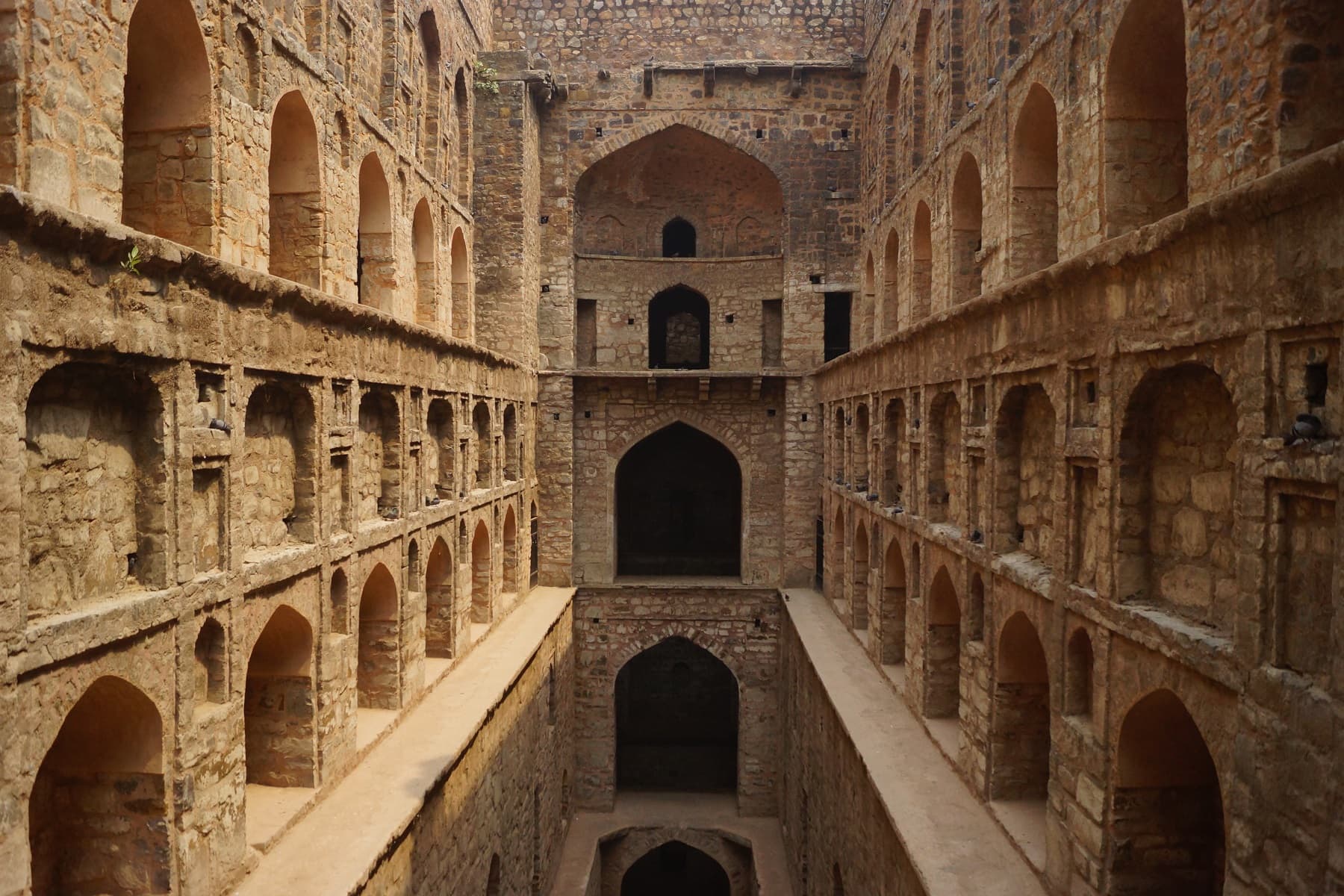
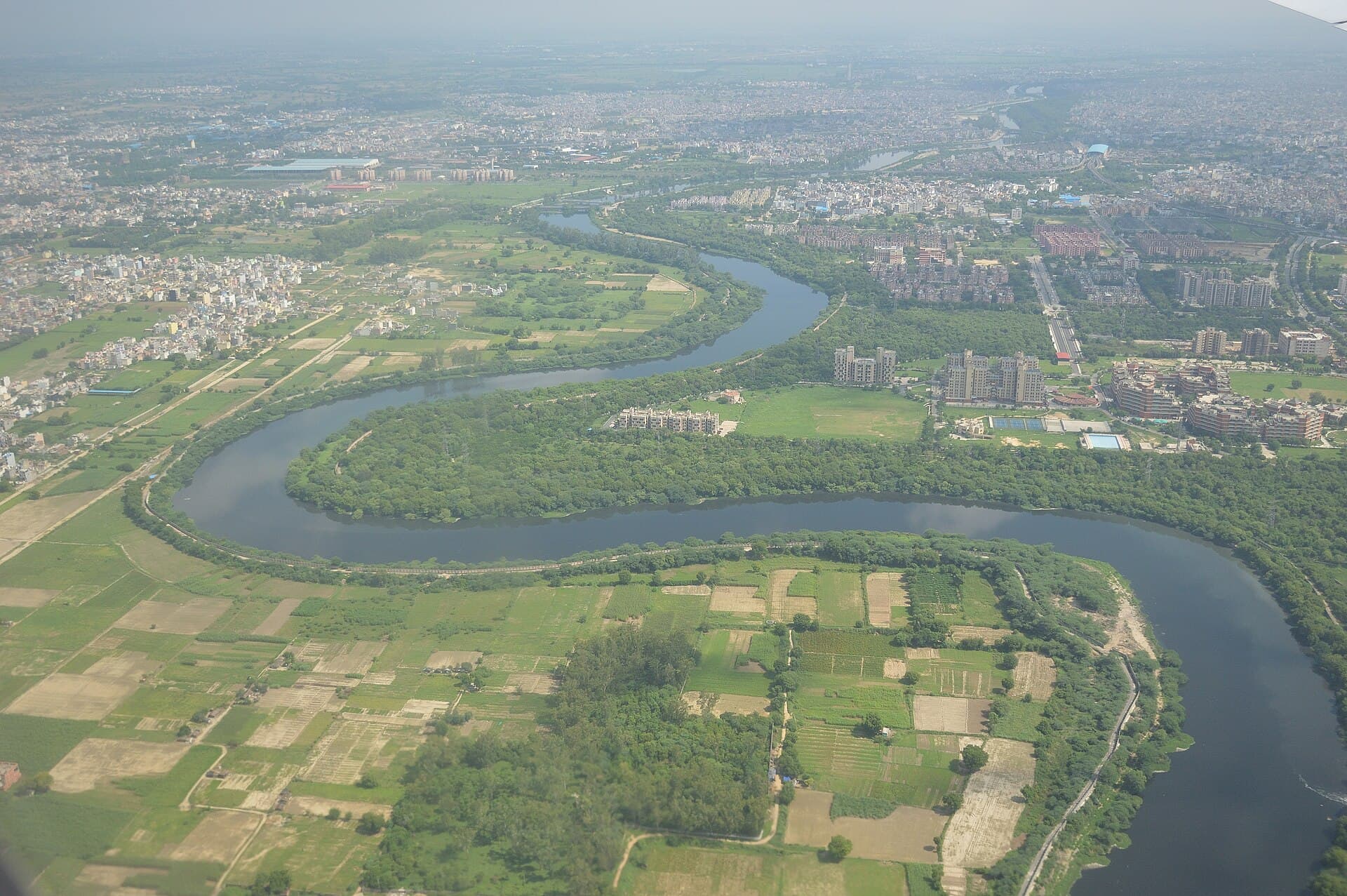
Two minutes from Connaught Place, behind the glass of Delhi's business district, a flight of a hundred and eight steps drops through arched stone galleries to a dry floor. Agrasen ki Baoli is a baoli (बावली) - a stepwell - and the steps exist because the people who built it expected the water to move: to stand high in a good year and sink in a hard one, always reachable, never gone. For roughly a thousand years that was Delhi's founding skill. Every dynasty that raised a capital on this dry plain built its water first - tanks, royal reservoirs, stepwells, a canal that ran through the heart of the city. Today the baoli is dry, the canal is a road, and Delhi owns no storage at all: nine treatment plants turn out roughly 960 million gallons a day of water that arrives from five other states, against a requirement its own auditor says it misses by a quarter. The city that once stored its own water now waits for water - and the river it waits beside carries, in the twenty-two kilometres it takes to cross town, about eighty per cent of the pollution of its entire thirteen-hundred-kilometre length.
Talab, hauz, baoli: the city built on stored water (c. 1052-1857)
Seven capitals rose on a plain with no perennial stream of their own - so each one engineered its water: a dam, a royal tank, a fortress of cisterns, and finally a canal of paradise.
Delhi's water story starts on the rocky southern ridge, where the rain runs off fast and the Yamuna is a day's walk away. The Tomar rajas who held the area around the eighth to eleventh centuries answered with masonry: at Anangpur, south of the city, a hundred-metre wall of dressed quartzite still stands across a ridge stream - India's oldest surviving gravity dam - feeding the stepped reservoir at Surajkund. Their tank at Lal Kot, the Anang Tal (c. 1052), watered the first of the capitals. The pattern was set: in this landscape a city is a machine for catching rain.
The Sultanate scaled the machine up. Iltutmish dug the royal tank of Hauz-i-Shamsi (हौज़-ए-शम्सी) at Mehrauli in 1230; it still holds water today, nearly eight centuries on. Alauddin Khalji excavated the vast Hauz Khas - the "special tank" - for his new city of Siri, and Firuz Shah Tughlaq, the great hydraulic obsessive of the fourteenth century, restored it in the 1350s and built his madrasa on its bund. Ghiyasuddin Tughlaq raised Tughlaqabad as a fortress of rainwater - rock-cut cisterns and stepwells inside the walls, a seasonal reservoir held by a bund outside them. At Satpula, a seven-arched dam doubled as a piece of the city wall. The stepwells multiplied - Agrasen's in the plain, Rajon and Gandhak in Mehrauli, the spring-fed baoli at Nizamuddin's dargah, dug, the story goes, by night when the Sultan had banned the work.
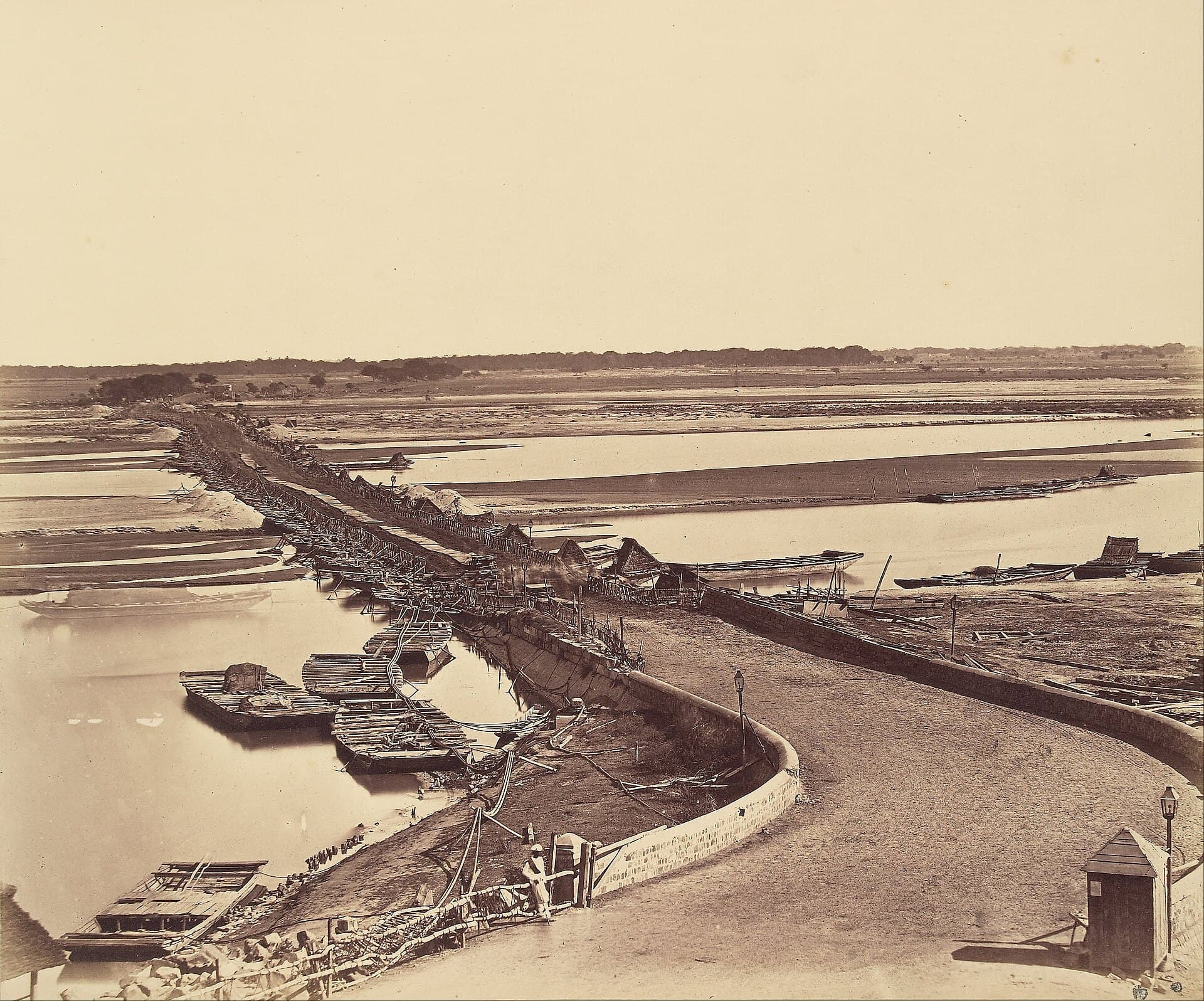
The Mughals completed the machine with a flourish. In 1638 Shah Jahan moved the capital to his new riverside city, and his engineer Ali Mardan Khan revived and extended Firuz Shah's old canal to carry Yamuna water more than a hundred kilometres from the north into Shahjahanabad. They called it the Nahar-i-Behisht (नहर-ए-बहिश्त) - the Stream of Paradise. It filled the channel down the centre of Chandni Chowk, fed the fountains of the Red Fort, and made a desert court a garden. A city of perhaps half a million people ran on stored rain, shallow wells, and one engineered canal - a system with no pumps, no treatment plants, and a thousand years of institutional memory.
“Every Delhi before the modern one can be read as a water plan with a fort attached.”
Drain the jheel, pump the river (1857-1947)
After 1857 the British dismantled the stored-water city - the canal filled in, the great lake drained, the water table left to the past - and replaced it with a pumped river and a pipe that served some Delhis better than others.
The Uprising of 1857 ended more than a dynasty. In the rebuilt, garrisoned Delhi that followed, the Nahar-i-Behisht was cut off and the Chandni Chowk channel eventually filled and paved - a security risk, an inconvenience, an anachronism to the new administration. The city's most sophisticated piece of water architecture became a tram route. What the canal had done for the walled city, a pump would now do: Delhi's first waterworks rose in the 1890s at Chandrawal, on the Yamuna's bank, pushing filtered river water into mains. The logic of the city flipped in a generation - from catch it where it falls to take it from the river and push it uphill.
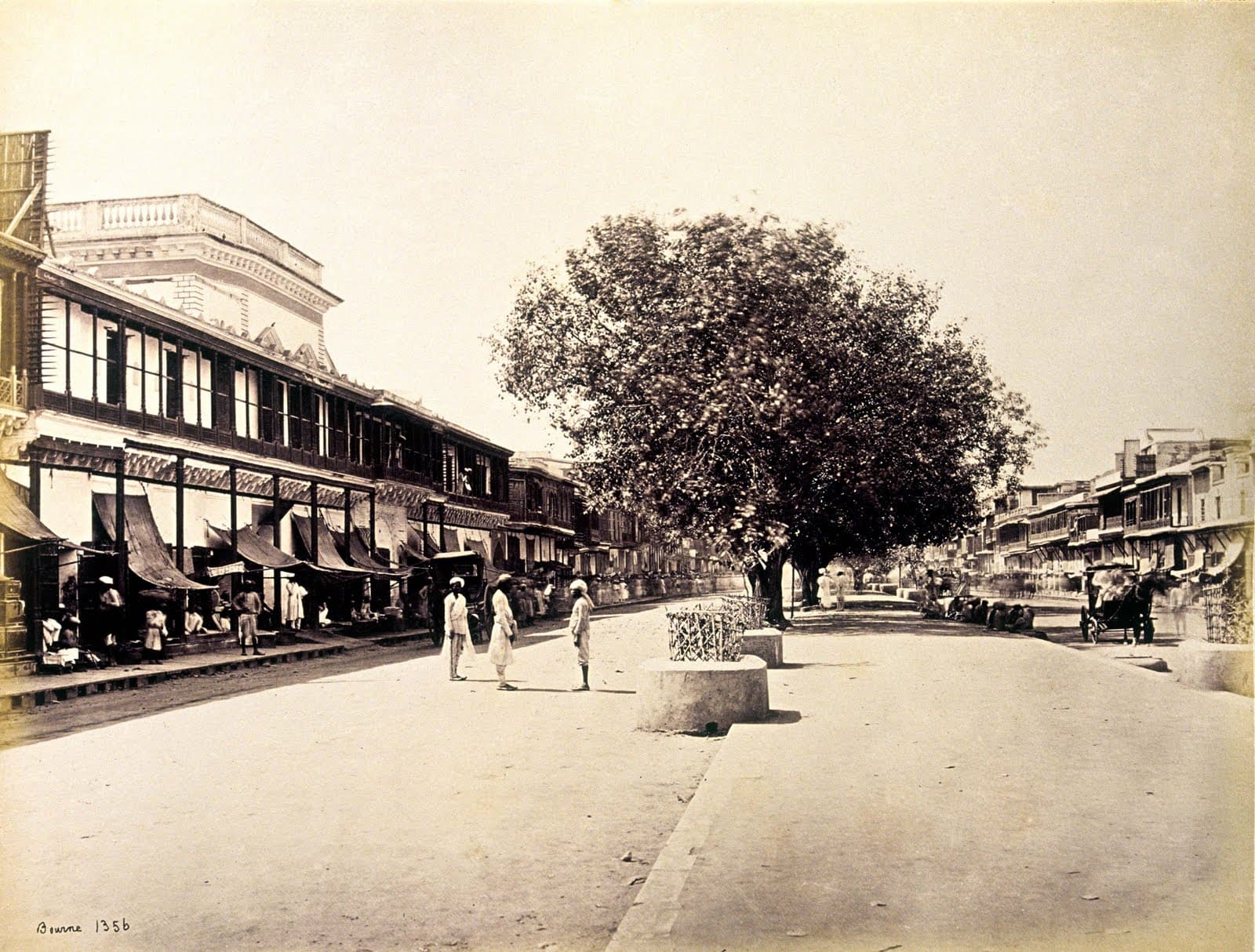
The same decades unmade Delhi's largest natural water body. South-west of the city, the Sahibi river ended in the Najafgarh Jheel (झील) - a shallow monsoon lake that in flood years spread over some two hundred and twenty-six square kilometres, a sea by Delhi's standards, and a malaria-and-flood problem by the administration's. From the 1860s the engineers cut it a channel to the Yamuna and kept cutting until the lake was gone. The channel survives. It is the Najafgarh nala (नाला) - today the single largest carrier of Delhi's sewage into the river, a drain that is also, if you trace its water back far enough, a buried river.
New Delhi, inaugurated in 1931, added the last colonial ingredient: inequality by design. The imperial capital's bungalow zone was plumbed generously; the old city and the settlements beyond were not. Water in Delhi has run along that gradient ever since - not scarcity for everyone, but abundance for some addresses and queues for others.
“The colonial city did not just take Delhi's water; it took Delhi's memory of having managed water at all.”
The Sutlej-Yamuna promise: a capital on other states' water (1947-2007)
Independent Delhi grew twenty-fold and solved each shortage the same way - a longer straw into somebody else's river - until its entire supply hung on a stack of inter-state promises.
Partition doubled the city almost overnight, and the decades after kept doubling it. Delhi's answer was reach. When Bhakra dam rose on the Sutlej in 1963, a share of its water turned into the capital - arriving, then as now, through Haryana's Western Yamuna Canal system, whose Munak carrier delivers roughly seventy per cent of Delhi's raw water across a hundred and two kilometres the city does not control. The straw kept lengthening: by the mid-2000s the Sonia Vihar plant was treating Ganga water released from Tehri dam in the Himalaya, three hundred cusecs earmarked for Delhi and carried down the Upper Ganga Canal.
The paper caught up with the plumbing in 1994, when five states - Himachal, Haryana, Uttar Pradesh, Rajasthan and Delhi - signed a memorandum dividing the upper Yamuna. Delhi's share: 0.724 billion cubic metres a year, with a clause putting the capital's drinking water first in a bad year. It was styled an interim allocation. Three decades later it is still the operative constitution of Delhi's water, administered by a river board whose public reports run years behind, for a canal with no public flow meter. In 1998 the Delhi Jal Board was created to run the city side of the bargain. And in February 2007 a retired forest officer named Manoj Misra founded the Yamuna Jiye Abhiyaan - the campaign that the river lives - and began asking, in courtrooms, the question the whole arrangement had been built not to ask: if everyone upstream takes their share, what is left of the river itself?
“In a deficit year, Delhi's drinking water is served first - the rest share what remains. The river is not listed among the parties.”
Aaj ka Yamuna: foam, floods, and the audit (2007-2026)
India's most-instrumented river stretch got worse while every number about it got better known - and the city's own auditor finally put figures on why.
On paper, the last two decades are the best-documented in the Yamuna's history. The National Green Tribunal ran Misra's case for over a decade and delivered the landmark "Maily Se Nirmal Yamuna" revitalisation judgment in 2015; a monitoring committee followed in 2018; Delhi's pollution watchdog now samples the river at eight stations and its drains at dozens more, every month - the highest-cadence public river feed in India. The numbers those instruments return are a diagnosis in public: the river arrives at Palla meeting the bathing standard, and leaves the city with its dissolved oxygen at nil and faecal bacteria more than a hundred times the limit. Every October, when the foam banks up white at Kalindi Kunj for Chhath, the diagnosis becomes a photograph. In November 2024 the Delhi High Court declined to permit the ritual on the riverbank at all - a court certifying, in effect, that the river is unfit for the festival that honours it.
The river can still remind the city whose floodplain it is. In July 2023 the Yamuna rose to 208.66 metres at the Old Railway Bridge - the highest level ever recorded there, a metre above a record that had stood since 1978 - and put the Ring Road under water; jammed gates at the ITO barrage deepened the flooding in the city's centre. Two monsoons later, in September 2025, an eerily similar spell repeated. Between the two floods, in June 2023, Manoj Misra died - on the same day a citizens' Yamuna parliament convened in Delhi to demand the river's revival.
Then, in March 2026, the city's own auditor tabled the reckoning. The CAG's performance audit of the Delhi Jal Board found fifty-one to fifty-three per cent of the water supply earning no revenue - nearly five thousand crore rupees lost - and total debts of Rs 66,595 crore; only forty per cent of the water produced was billed at all, and there was not a working flow meter at the plants, the reservoirs or the borewells to say precisely where the rest went. The state's own Economic Survey uses the word "mafia" for where some of it goes. Beneath the streets the story repeats: the groundwater assessments now published annually show the capital pumping more than nature returns, with New Delhi district extracting over a hundred and twenty per cent of its recharge. And the master plan for 2041 quietly concedes the arithmetic - it sets the future demand target at 1,455 million gallons a day by cutting the per-person norm from sixty gallons to fifty.
Delhi has more data about its river than any Indian city has about any river - and the river got worse anyway. That is the uncomfortable finding under all the others: the capital's water problem is not a measurement problem, and it is no longer even a scarcity problem alone. It is a promises problem. The MoU promises a share; the canal delivers what it delivers, unmetered. The plans promise treatment capacity by dates that pass quietly. The baoli behind Connaught Place promises nothing - but for a thousand years, it delivered. The question this dashboard exists to keep asking is the one Misra took to court: not how much water can Delhi take, but what does Delhi owe the water it takes?
“In Delhi the river was never lost to ignorance. It was lost in full view, with the instruments running.”